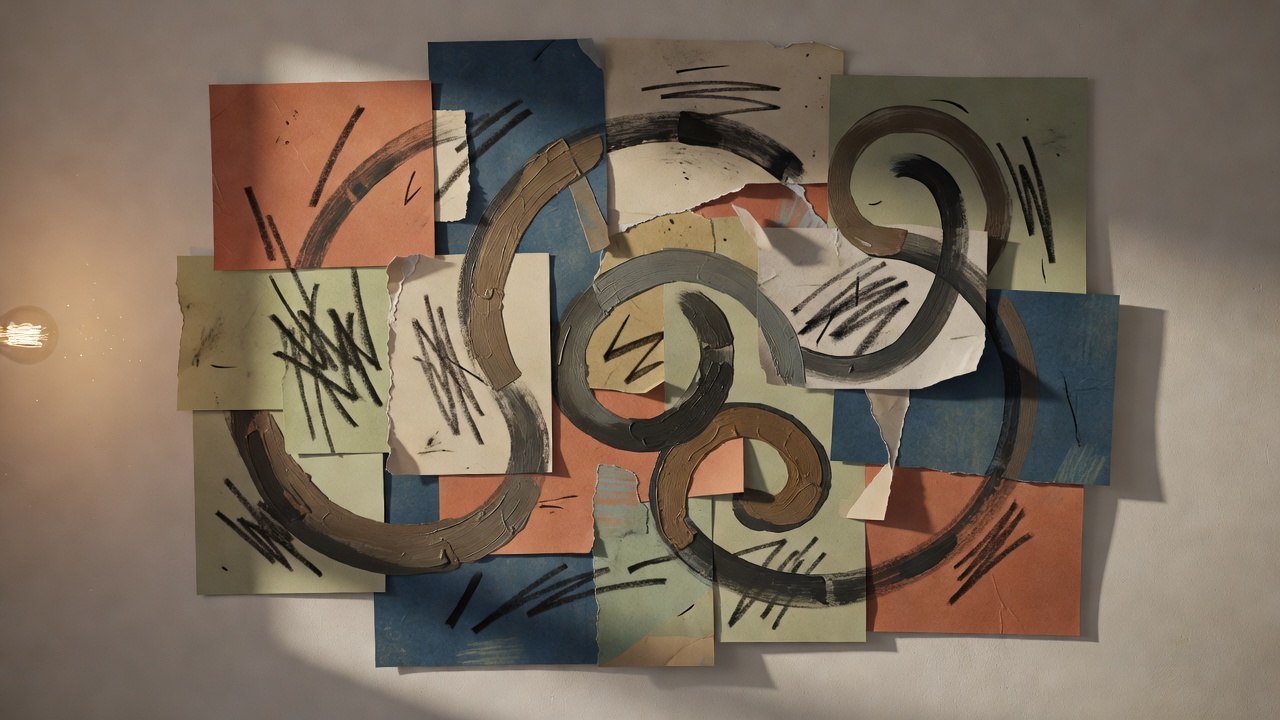
By now you may have a strip of rhythm marks, a sheet of melody lines and a labelled palette. Each is a partial translation. This station brings them together into one composition. The aim is not to illustrate a song literally but to give its feeling somewhere to stay, so that a viewer — or you, months later — can sense something of the original listening.
Think of a piece of music as having depth. There is often a sustained background (pads, strings, room tone), a rhythmic middle and a melodic foreground. Painters have a matching vocabulary of ground, middle and surface. Building in that order keeps the work readable.
Step-by-step: building the layers
Lay the ground
Tape your sheet down on all four edges. With the wide brush, lay a thin wash of your quietest palette colour across the whole page — or only part of it, if the track feels like it occupies a corner of the room. Let it dry fully. This is the atmosphere, the sustained tone underneath everything.
Add the rhythm layer
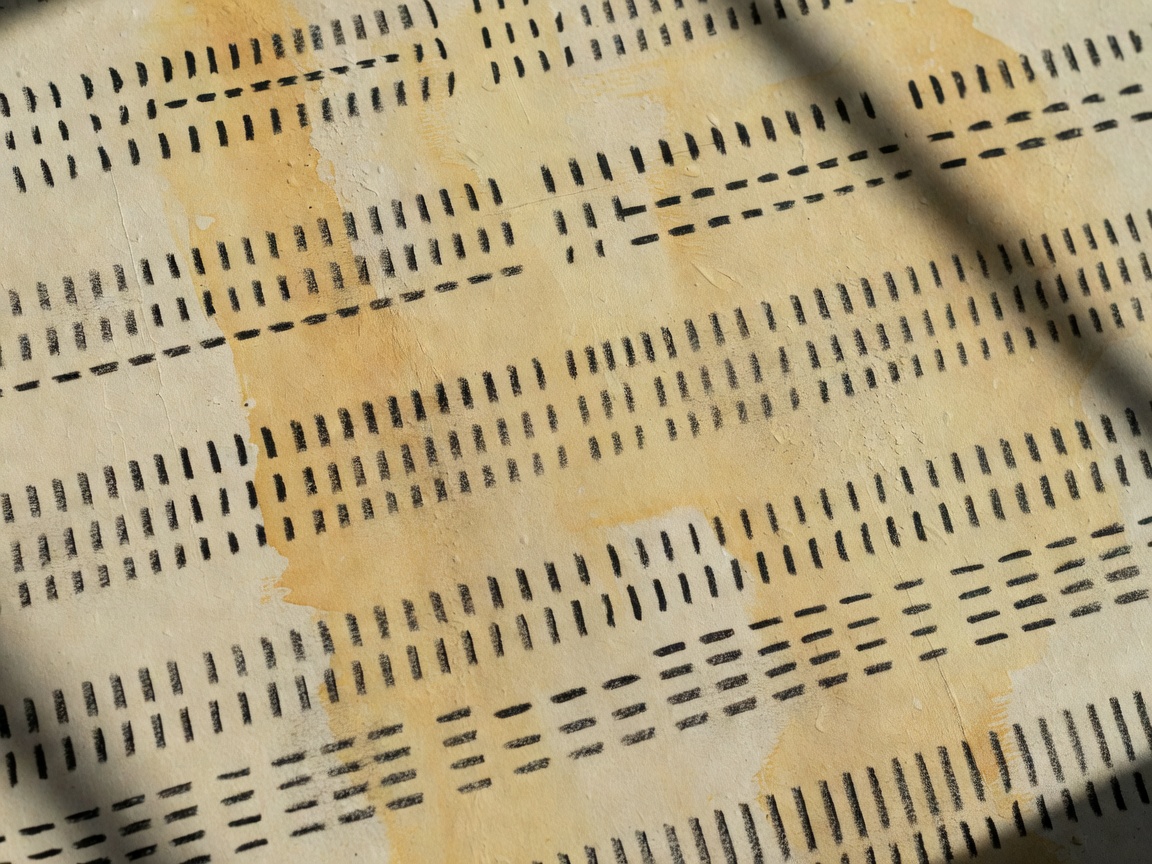
- Wash left uneven where the intro felt hazy.
- Accented beats in thicker charcoal.
- A deliberate empty band for the bridge's silence.
Play the track and repeat your rhythm marks directly onto the dried wash, using your strongest colour or charcoal. Refer to your test strips but do not copy them; let this be a fresh performance. If the beat drops out in the bridge, leave a band of untouched ground.
Draw the melody on top
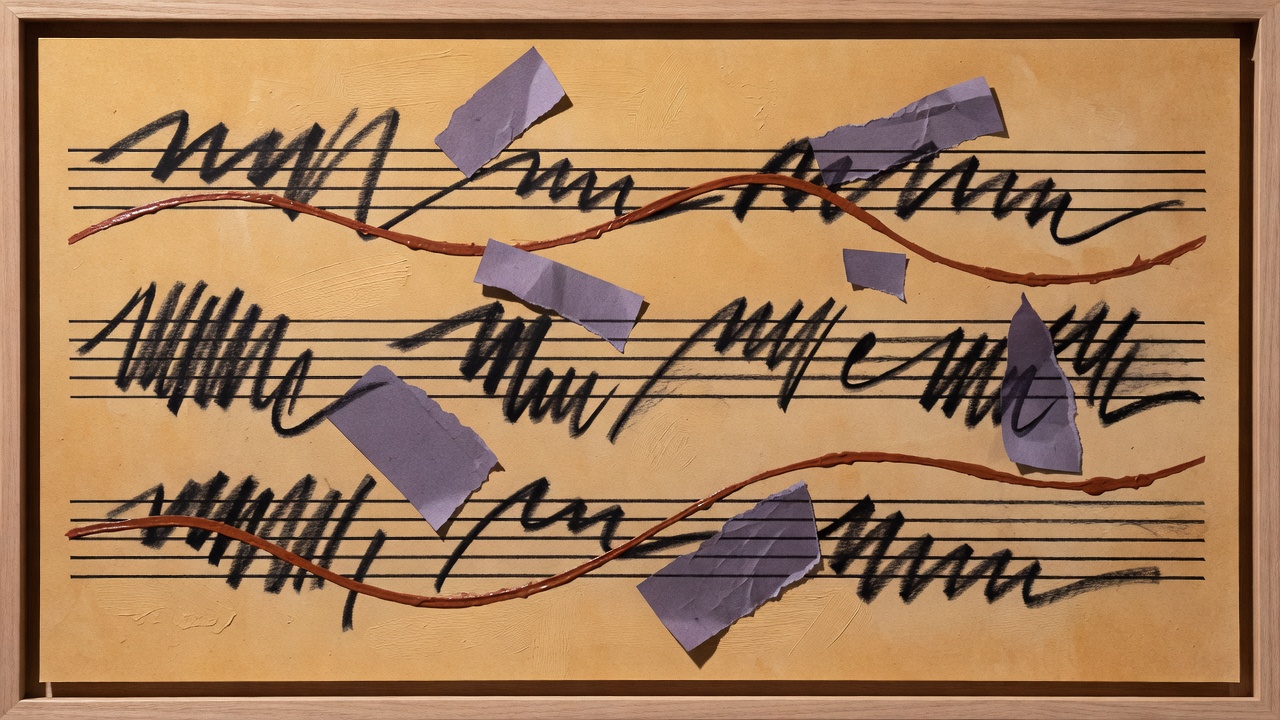
With the narrow brush and your middle colour, draw one or two key phrases across the rhythm layer. Allow the line to cross marks rather than avoid them; in music, melody rides over rhythm. Two phrases are usually enough. A page crowded with every phrase becomes noise.
Edit with paper
Cut or tear a few shapes from scrap paper tinted with your palette. Move them around the composition while the music plays. Glue down only those that feel like part of the sound — a held chord, a vocal harmony, a change of key. Layered paper adds physical depth that echoes the depth of the mix.
Title and caption
Remove the tape slowly. On the back, write the track, performer, date and your three listening words, plus a sentence on one choice you made. If you exhibit or share the work, include that caption. It invites viewers to compare their hearing with yours.
Layered listening in art history
James McNeill Whistler gave many of his London river paintings of the 1870s musical titles such as Nocturne and Symphony, insisting that a painting, like music, could be enjoyed for arrangements of tone rather than story. Wassily Kandinsky's Composition VII (1913), held by the State Tretyakov Gallery in Moscow, layers colour fields, lines and dense marks in a way he likened to orchestration. His notebooks describe sounds he associated with particular colours, though he wrote as an artist exploring, not a scientist reporting.
In film, Oskar Fischinger's An Optical Poem (1938), set to Liszt's Hungarian Rhapsody No. 2, moves paper shapes in time with the music. Georgia O'Keeffe titled several early abstractions after music, including Music, Pink and Blue No. 2 (1918), now at the Whitney Museum of American Art. Each artist built a visual structure answering to what they heard.
Reflection: which layer carries the most feeling?
Cover each layer in turn with a sheet of paper. Notice which removal changes the mood most. That layer is often the heart of your translation.
Reflection: what would someone else make of the same track?
Invite a friend to make their own sheet from the same song without seeing yours. Lay them side by side. The differences are a portrait of two ways of listening.