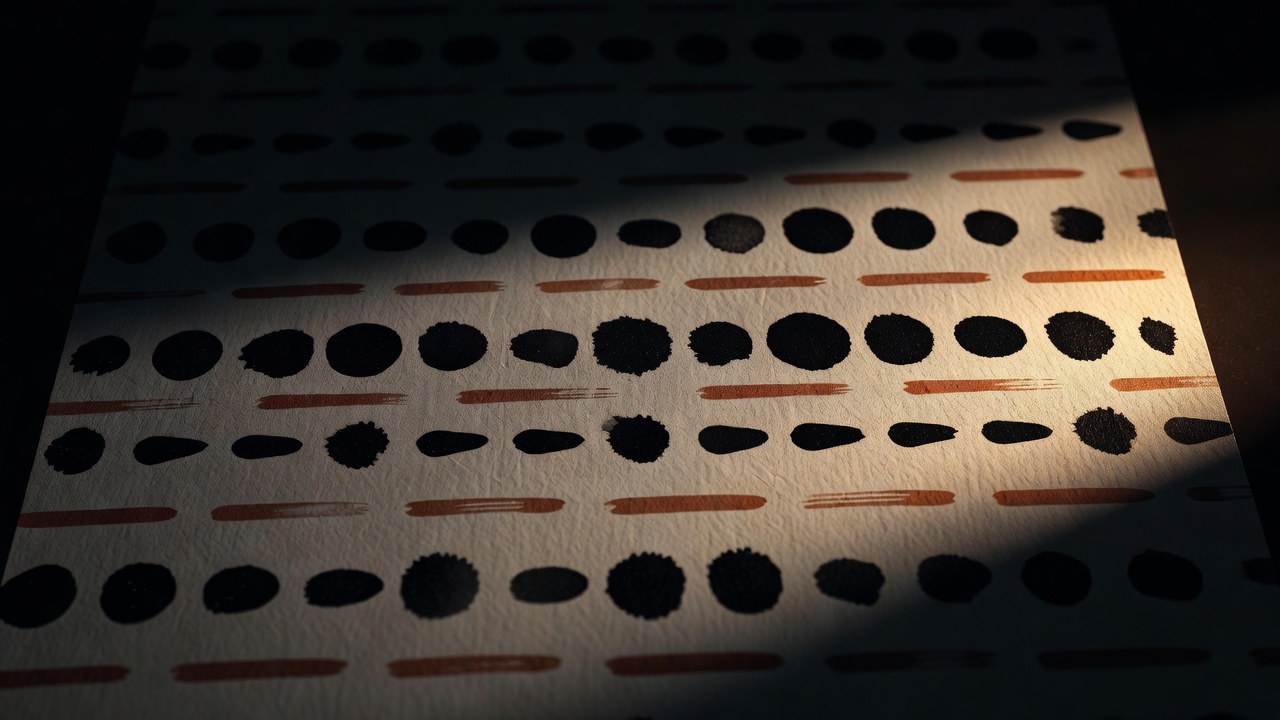
Before melody or harmony, most of us respond to music with a foot, a nod or a hand on the table. That instinct is the starting point here. You do not need to count bars or know a time signature. You need a pencil, a scrap of paper and a track with a beat you can feel.
Three words will help. The pulse is the steady count underneath the music — the thing you tap. Accents are the beats that land with more weight. Rests are silences, short or long. A fourth word, syncopation, describes accents that fall between the expected beats, the off-balance push you hear in jazz, funk and a great deal of pop.
The demonstration below moves through these ideas one at a time. Spend a few minutes at each step, and use a fresh strip of paper for each so you can compare them later.
A step-by-step mark-making demonstration
Tap the pulse for thirty seconds
Hold the pencil loosely and let it fall once per beat, moving slowly from left to right as if writing. Do not look at the paper for the first ten seconds. When you look, you will see a little record of your listening: perhaps even, perhaps drifting closer together as you got excited. Both are honest.
Give the accents weight
Play the same passage again. This time press harder, or widen the mark, on the beats that feel strongest. In much dance music the first beat of each group of four lands hardest; in a waltz it is one of every three. You will find the grouping by feel. Your strip now shows a pattern of large and small marks — the beginning of a visual metre.
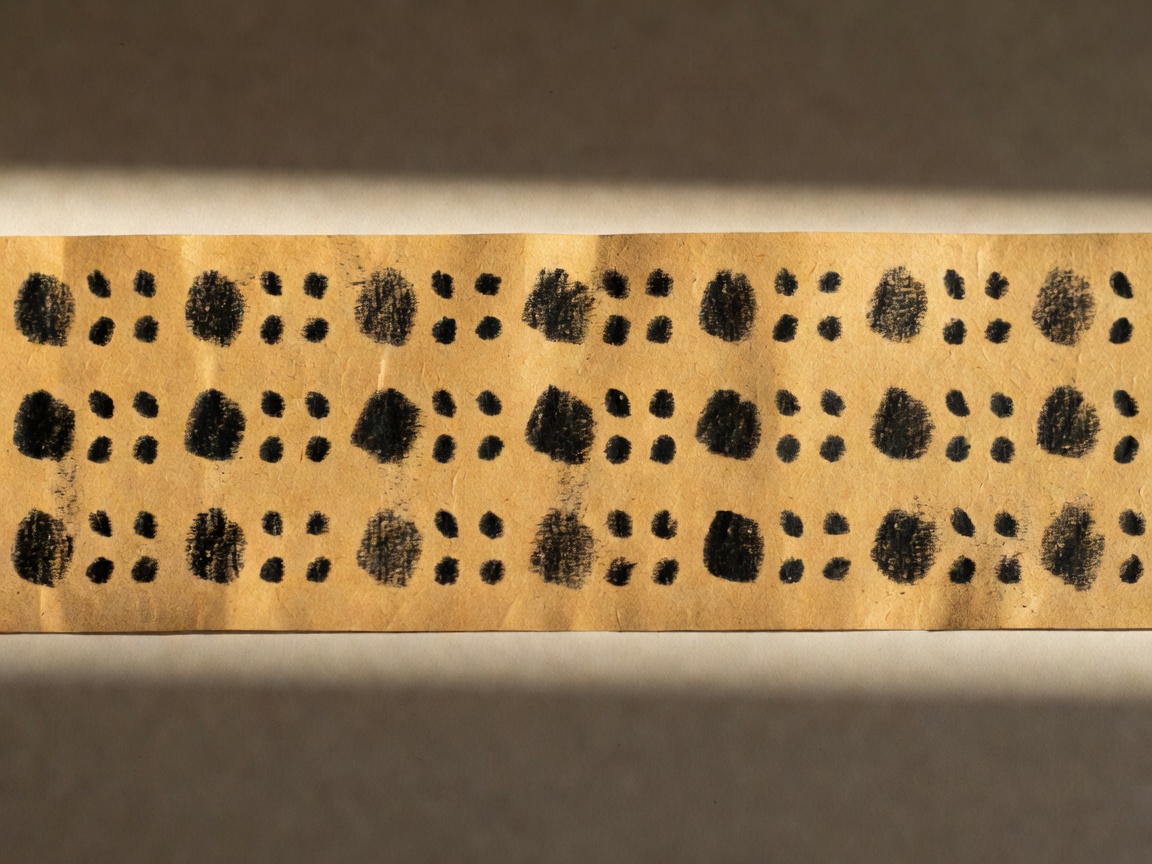
- Heavy dab on each first beat.
- Lighter touches on beats two to four.
- The gap widens where the drummer held back.
Leave space for the rests
Find a passage where the music pauses, even briefly. Keep your hand moving across the page at the same speed, but do not touch down. The blank paper becomes silence. Composers think about rests carefully; visual artists call the equivalent negative space. Notice how a gap changes the feeling of the marks on either side.
Change tools for syncopation
Hold the narrow brush in your other hand. Keep tapping the pulse with the pencil, and use the brush only for the off-beat pushes — the snare that lands just late, the guitar that jumps ahead. Two tools, two layers of time. If this feels clumsy, it is working: syncopation is meant to unsettle the steady count.
Compare strips
Lay your four strips side by side. Which one feels closest to the track? Which one surprised you? Keep them; they will become the rhythm layer of your layered artwork.
Artists who made rhythm visible
Piet Mondrian's Broadway Boogie Woogie (1942–43), now at the Museum of Modern Art in New York, translates the bouncing left hand of boogie-woogie piano and the grid of Manhattan into small blocks of yellow, red and grey that seem to pulse along their lines. Mondrian loved to dance, and the painting is often read as a city heard through jazz — though that reading belongs to viewers as much as to him.
František Kupka's Amorpha, Fugue in Two Colours (1912), held by the National Gallery Prague, borrowed a musical form to organise interlocking curves. The animator Norman McLaren went further in Synchromy (1971), made for the National Film Board of Canada, where the shapes printed on the film's soundtrack area are literally what you hear.
None of these artists offer a code for you to follow. They show a range of responses, each shaped by a particular ear and hand.
Reflection: did your marks speed up?
Many people unconsciously quicken as the music builds. That drift is information about how the track made you feel, and it is worth keeping rather than correcting.
Reflection: what would a slower piece look like?
Try the same exercise with something without a clear beat — a drone or an ambient piece. You may find yourself making longer, softer marks, or none at all. Both are valid translations.